Wednesday, November 27, 2013

Sonnet Instructions!

Happy Thanksgiving Everyone!!!  I hope you're all feeling deliciously well fed. :)

Instructions for the sonnet:
  • 14 lines
  • Rhyme scheme: abab cdcd efef gg
  • Each quatrain should have its own contained idea, and the ending couplet should provide the "key" to understanding the poem.
  • Do your best to write in iambic pentameter (each line should be 10 syllables of alternating unstressed/stressed syllables: "i WANT to EAT the WHOLE enTIre PIE!"  But-- obviously-- you can spell normally.)
  • Remember, serious form often relates to significant subjects.  Not a requirement; just a suggestion.
Also: here are ways that Shakespeare allowed himself to bend the rules a little when the rhyming and meter got tough:
  • You can combine words to take out a syllable; just note the missing letters with an apostrophe: "It is" --> "'tis" / "In faith" simply becomes " 'Faith" / "Overtook in his rousing" becomes "o'ertook in’s rouse."  Try not to do this too often, but if you're desperate, combine!
  • You can also write a line of 11 syllables, provided the last syllable is unstressed.  This is called a "feminine ending," because it is is unstressed.   And seeing as women never get stressed, it makes sense.
  • He also sometimes invented words.  Not saying you should start Dr. Seussing or anything, but if we're emulating The Bard... well, the man did coin some diction!
And if you're feeling REALLY ambitious...
  • Consider employing some of the literary devices we've been discovering this year.  Employ beautiful words to convey a soothing tone; employ harsh and ugly words to convey a disturbed tone.
  • Figurative language is also great: personfication, paradox, metaphor, simile... have at 'em!
  • Imagery can be great if you want to create some symbolism-- think of all the symbolic meanings associated with things found in nature!  Could some of those lend themselves to your meaning?
Finally: it's okay if it's not brilliant! 
The main reason we're doing this is so that you all internalize the form and function of a sonnet, as well as experience the challenge of writing in meter and verse so that you can better appreciate what Shakespeare did.  But I don't expect you to write like Shakespeare (Keaton, you can consider that a challenge), so don't put too much pressure on yourself!  I'm excited to read them!!

Need inspiration?  The link below will take you to a website where Shakespeare's sonnets can be read to your hearts' content.
http://www.shakespeare-online.com/sonnets/

Wednesday, November 20, 2013

Video: Hamlet, Act 1, scene 5

http://www.youtube.com/watch?v=5-tYlYJ0PJM  (start the scene at about 3:50 if you want to go straight to scene 5)

Questions to consider as you watch this and look over the scene in your scripts:
1.) How does the ghost say he was murdered?
2.) What does the ghost tell Hamlet about Gertrude, or any plans Hamlet may form to avenge himself against her?
3.) After the ghost leaves, Hamlet is frantically processing what the ghost has told him.  In your opinion, does the text imply Hamlet is becoming mentally unstable?
4.) When Horatio and Marcellus enter, Hamlet greets them oddly.  (David Tennant does a great job emphasizing the strangeness of Hamlet's words; an actor could choose to play those lines much more straight, but even so, the lines seem bizarre, and the iambic pentameter falls apart.  Horatio points out, aptly, "These are but wild and whirling words!")  Why do you think Hamlet has them repeatedly swear they will not tell anyone what they have seen that night?  (NOTE: in the play, there is no specific stage instruction for Hamlet to cut his hand.)  Why would Hamlet greet them so strangely, or make jokes about the ghost's rumbles, calling the ghost "an old mole" and "truepenny" (slang for "honest old fellow.")  Why would Shakespeare malign the verse in this part?
5.) What does it mean when Hamlet tells his two friends that, from here on out, he "might think it meet to put an antic disposition on"?

Analysis:
1.) Hamlet tells his father's ghost "with wings as swift as meditation or thoughts of love [I will] sweep to my revenge" but at the end of the scene he says: "Oh cursed spite that ever I was born to set it right."  Do you think Hamlet is eager to avenge his father's murder?  Do you expect he'll be good at taking that revenge?  What clues from the text inform your guesses?
2.) In your opinion, is Hamlet acting mad (insane) here, actually going mad here, or just emotionally distraught, as would be expected?

Tuesday, November 19, 2013

Hamlet video: Act 1, scene 1

Click on the link below to watch the opening scene of Hamlet.  NOTE: although Hamlet is written to take place during the medieval era in Denmark, modern productions often set it in a more contemporary time period.  In this production, Hamlet is set in modern day.  Enjoy!

http://www.youtube.com/watch?v=U-NLnsq3P7Y

Thursday, November 14, 2013

Antigone Blog: due by 11:59pm, 11-15-2013

In the lecture I gave you all on Tragedy, there was a quote towards the end from an introduction of the Theban plays, discussing Antigone.  The quote states:

“[Here is] tragedy– not in the martyrdom of obvious right under obvious wrong, but in the far more bitter, and at the same time more exhilerating, contest between two passionately held principles of right, each partly justifiable, and each to a degree (though one more than the other) vitiated by stubborn blindness to the merits of the opposite.” (Watling 11)

The quote reminds us that, although Creon's edict is ultimately shown by Sophocles to be incorrect, the two principles at odds are both essentially valid: on the one hand, the play is concerned with upholding the security of the city; on the other, we are confronted with the importance of upholding the timeless will of the gods.  Antigone ultimately would have posed a very challenging conundrum to its original audience since-- as the Chorus demonstrates-- at times, one principle seems more valid; at times, the other emerges as best.

Your assignment:
  • Based on the character you were assigned, write a first-person justification of that character's perspective.  Some characters struggle with both (or more!) principles, so explain fully the thought process of those characters.  Some characters have a controversial stance, so (in character) justify that stance as passionately as that character would.
  • Do your best to emulate the style of speech used in the play, and incorporate at least three CDs from the play, with citations.  Those quotes should be lines that your character actually says.
  • Shoot for two long-ish paragraphs, and remember to incorporate those three CDs.

Remember: it's our job as readers to seek to understand these characters, not judge them.  Although it may be tempting to showcase your character as a two-dimensional nincompoop, try to imagine yourself actually in their shoes, and do your best to explore their complex motivations.

Part Assignments:
Antigone: Cassidy, Hannah S, Bryce
Haemon: Eric, Mariah, Keaton 
Teresias: Jon, Hanna K,  Nathan
Chorus: Madison, Amy, Rachel
Ismene: Mel, Tori, Dani
Creon: Sonia, Leyla, Matthew

Wednesday, October 16, 2013

Writing about yourself as a COMPLEX character: due Fri 10/18 by 11:59pm

COMPLEX: that's a word we're going to see a lot this year, and probably the favorite word of the AP prompt-writers.  Complex is a code word.  The AP prompt writers don't necessarily want you to be able to decipher the code, but I want you to know the code.  When you see this word, you should immediately translate it to mean:

There are two seemingly contradictory sides to this situation.
 
And therefore: you need to FIND the two seemingly dichotomous sides.
 
If the AP prompt asks you to discuss a complex character, you need to find two seemingly-opposite sides to the character.  (He is both insecure AND arrogant. / The author shows that she feels both love AND animosity towards her brother.) 
 
If the AP prompt asks you to discuss the author's complex attitude towards [whatever], you need to find two seemingly diametric attitudes present in the text.  In John Donne's poem about love, "The Broken Heart" (we read this in class), the imagery reveals that he considers love both destructive AND irresistable.  We might say that Lutie had a complex relationship with the city's urban environment in that, though the city antagonizes Lutie, she nevertheless relies on it for her survival.
 
Good authors portray their characters and their themes as complex, because life IS complex. Good AP Lit students likewise identify complexities in texts because they're smart, and they know that life is complex.
 
So!  To help you internalize this concept and simultaneously help you understand better how authors use direct and indirect methods to provide characterization, you are going to write about YOURSELF as a complex character.
 
Here are the rules:
1.) You may not write in first person as yourself.  You can write in first person as someone else observing you, but you cannot simply describe yourself in first person.
2.) You can also write in limited 3rd person, in omniscient 3rd person, or in 2nd person. (If you can't remember what these different points of view are, refer to the "Point of View" chapter in your brown textbook.)
3.) You need to reveal two apparently diametric sides of yourself.
4.) You need to employ mostly indirect methods of characterization.  (Try your best.)
 
If you need an example, I've provided one below.
-----------------------------------------------------------------------------------------------
Note: yours doesn't have to be this long.  I started having fun with this and just kept it going.
The waiters must have puzzled over the sight.  There, in the middle of the Chinese restaurant at approximately 4:30 in the afternoon, sat three senior citizens and one young woman.  The girl was too old to be under the guardianship of any of her elderly tablemates, but too young to have any plausible reason for being there.  One waitress speculated that she was the trophy wife of the man seated next to her, but was quickly rebuffed by the hostess who pointed out that there was no flashy jewelry on her hands.  Someone else guessed she might be a hired nurse for one of the others, yet that theory too was challenged when it was observed the elder guests appeared to be relatively spry--even lively.  A snippet of conversation finally revealed the mystery; the girl was overheard asking her “Grandpa” to pass the water pitcher.   The wait staff rolled their eyes at the disclosure; it was a disappointingly ordinary explanation.
At one point, the girl furtively examined her phone, sneaking it past the watchful gaze of her dinner partners, who would certainly have declaimed the device as a sign of her generation’s imminent demise.  She scowled at the words on the screen and pushed it back into her purse with a shove.  Her participation in the conversation noticeably dwindled; her head bowed in a sulk as she listlessly pushed her food across her plate, only raising her head to eventually acknowledge the arrival of the check—not that she was paying. 
Later, the girl and her grandfather would travel to their shared home; he would chat happily about the musical they had seen and make various proposals for how they might spend their evening.  She, in turn, would listen to his movie suggestions—always political thrillers—and continue brooding.   His comment about the lead actor’s antics drew a half-hearted smile; then, she turned away to look out at the fading afternoon.  She hoped he didn’t notice her sigh.
Once arriving home, there was only one thing to do.  The political thriller could wait. 
“Grandpa?  I’m going for a bike ride.  I’ll be back in an hour.”
“It’ll be dark soon sweetheart,” he responded, ever mindful of his granddaughter’s well-being.
“I know.  I’ll be back before then.”  She pushed the garage door open, and reminded herself to call back to him.  “Love you Gramps.”
“Love you sweetheart.”
The Burke-Gilman trail opened up beneath the rubber tires which churned over the cement.  She gulped in the air, tasting the crispness of summer slipping away.  “Why be angry?” she demanded of herself.  It had been her choice to stay with her grandpa, after all.  The thought made her legs push the pedals down harder and the bike leapt forward, jolting her body over potholes, gobbling up dried leaves foolish enough to drift in its way.  The burning of her muscles only seemed to increase her frustration.  It was just a weekend-- just a stupid weekend.  She mentally berated herself.  “So ungrateful.”
She rode past the Metropolitan Market, impatiently maneuvering her bike through the slow pedestrians dawdling at the crosswalk.  On through the shadowy stretch, the long gradual hill where it always got darkest first.  Then past the University building with the inexplicable waterfalls, great sheets of water on the second story, pounding down from what appeared to be the underside of the brick ceiling.  She didn’t have the patience to wonder about its presence or purpose today, and pushed on.
The goal had been to make it to Gasworks Park, but the sun’s low sling in the sky wouldn’t give her time for that.  With a sigh, she decided to push the bike up into campus instead.  Maybe the fountain would be on.  The rhythm of her breathing offered up a mantra: let it go, let it go, let it go. 
Keeping her eyes on the crunching gravel path which stretched uphill towards campus, she didn’t notice the roses until their scent accosted her. She glanced up at her surroundings and instinctively squeezed the hand brake to stop.
It was beautiful.
The late summer sunshine had left the wide circle of roses in shadow, but its warmth hadn’t left their petals; their sweet perfume wafted around her.  The fountain in the center of them all burst up its tall pillar of spray, each droplet falling and rippling into the pool below.
It was so beautiful.
Slowly, she eased the bike forward with the same solemn awe one finds in museum visitors as they take in priceless works of art.  Riding her bike in a slow circle around the fountain, she gazed at the full roses surrounding it—lavender, magenta, yellow and orange, the palest pink, and the deepest red.  Then she looked up towards the great height of the fountain’s spray.  The stream’s highest 18 inches managed to reach above the long shadows cast by the surrounding brick buildings, and where it leapt up into the fading sun, it became miraculous.  The prism of water caught all the rich colors of the light and refracted them in beams, in rainbows, in tosses and whirls of color.  The girl sucked in her breath, and stared at the pillar’s summit with rapt concentration. 
Suddenly, the phrase beamed into her head, without prompting, without reflection.  It didn’t even seem to belong to her, but its message was more insistent and clear than her own tangle of thoughts ever managed to be.
This is here for you to find, every day. 
She turned the phrase over in her mind, testing it.  She tasted the words, and let their message work peace into her synapses, her marrow, her red and white cells, her fibers and tendons and pores.  It was like waking from a heavy sleep. 
Breathing deeply, she slowly rode once more around the path encircling the fountain, doing her best to drink in the medicinal beauty that surrounded her. 
Then, she pointed the bike towards home.
The lightness that had eluded her all weekend clipped along beside her.  With her head raised and her eyes bright from either cold or revelation, the pedals moved readily beneath her feet.  She grinned as she pushed the bike into the garage, and pulled her helmet off.
“Grandpa?” she called eagerly, entering the house.
“Hiiii!” he called, in the way he always did.  “Perfect timing!  ‘Dancing with the Stars’ just ended!”
“Oh good!” she called back.  “Do you have your dessert yet?  I can warm up the applesauce if you want.”
“I’ll do it,” he said, thumping lightly down the stairs in his slippers and sweats.  “You go ahead and change, and then you can help me with the cookies.”  He passed her on the landing and grinned.  “What do you think about ‘Pelican Brief’ tonight?”
“A political thriller?” she grinned, feigning surprise.  “You? Want to watch a political thriller?”
“You know how I love political thrillers,” he called from the kitchen.
She did.  And she was once more able to love him for it.


Thursday, October 10, 2013

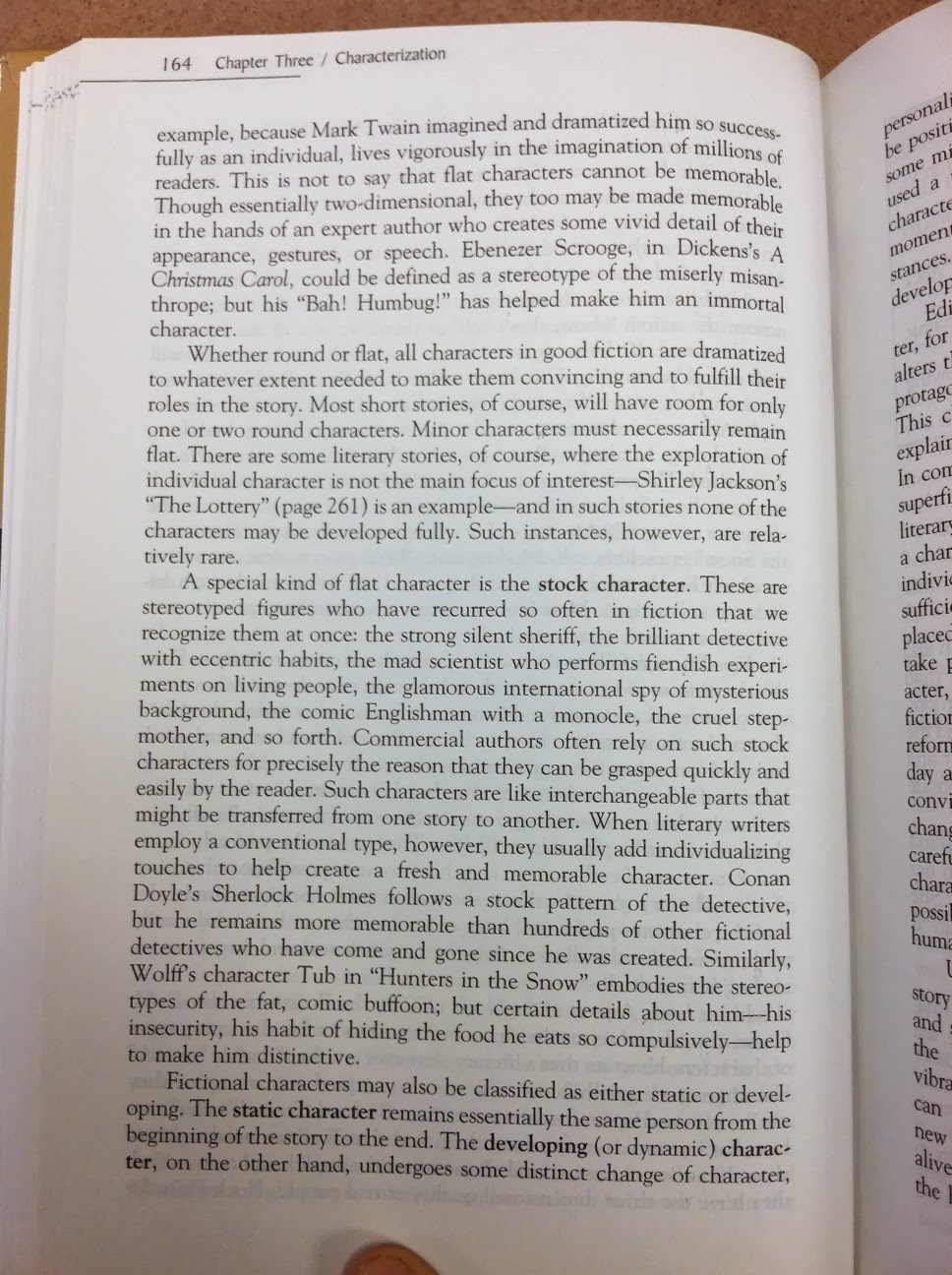
Characterization Questions (and pictures of the pages from the textbook)


There are pictures of the  "Characterization" chapter in your textbook if you forgot to take yours home.  Click on the pics at the bottom and do your best to read it!  Note: all pictures are from:
Arp, Thomas R., ed. "Characterization." Perrine's Literature: Structure, Sound, & Sense. 10th ed. Boston: Wadsworth CENGAGE Learning, MA. 161-65. Print.
 
AP Literature-- Characterization:

Read the chapter on Characterization in your AP textbook (p. 161-165), and use it to answer the questions below.  Type out your answers on a separate sheet of paper.  2-3 sentences should be sufficient for most questions.

1.)    The text states: "Such fiction offers an exciting opportunity to observe human nature in all its complexity and multiplicity. It enables us to know people, to understand them, and to develop compassion for them in a way we might not do without reading serious fiction" (162). Do you agree? Does Dostoyevsky accomplish this with Raskolnikov? (Do you know him, understand him, feel compassion for him?)  Explain why or why not you think so.

2.)     Is Raskolnikov's character primarily revealed directly or indirectly? Is he dramatized?  How do you know?

3.)    The text states, "Good fiction follows three other principles of characterization. First, the characters are consistent in their behavior: they do not behave one way on one occasion and a different way on another unless there is a clear and sufficient reason for the change" (163). Is Raskolnikov's behavior consistent?

4.)    What are some of Raskolnikov's main motivations for committing the murder? Is there one that seems foremost?

5.)    Who are C&P's flat characters?


6.)    Who are the round characters?


7.)    Are there any stock characters?


8.)    Which characters are static? Which are developing/dynamic?


9.)     Where are moments of epiphany in C&P?

10.)   Examine the three conditions of a convincing change of character, listed on p. 165. Does Raskolnikov's character change meet these qualifications?


Thursday, October 3, 2013

Peer Editing your partner's Personal Statement


Name: _______________________________________________________________________ per:_____________

Name of the person whose essay you’re editing: ______________________________________________________

NOTE to AP students: since you’re accessing your partner’s personal statement via blog, I recommend you copy and paste the text into a word doc and edit it there using the “review” feature, or print it out and edit it by hand.  If you and your partner want to email each other a word doc instead, or use Google docs, that’s fine too.  Please still post your personal statement on the blog for a grade. (And so I can make sure you’re making progress! J)

Personal Statements Peer-editing

After checking for each bulleted point, initial beside the bullet to indicate you did this piece of editing.

·         Read through the essay aloud, slowly, to the writer and any other peer editors.  As you read, mark the following:

o   awkward phrasing with a squiggly line and an “awk” notation.

o   circle any misspelled words

o   circle any misused or missing punctuation marks

o   suggest corrections for any awkward word choices

o   draw a question mark next to anything confusing

o   THESE ESSAYS NEED TO BE LITERALLY PERFECT IN TERMS OF GRAMMAR, SPELLING AND SENTENCE FLUENCY.  MARK ANYTHING THAT IS NOT PERFECT.

·         It is imperative that this essay flows smoothly.  Note on the margins where the essay seems choppy or disconnected.

·         Assess the intro hook:

o   Is it attention getting? 

o   Is it overly cheesy?  Does it feel forced or strained?

o   Does it make sense?  Does it leave too much information OUT?  Remember: the hook should make you want to know more, but it should not make you feel confused and/or frustrated.

o   WRITE ANY NEEDED IMPROVEMENTS IN THE MARGINS

·         Assess the story telling

o   Does it convey the writer’s “voice”?  Does it sound like them?  If it’s not written yet, do you think the story sounds like it will be true to the author?

o   Are there good sensory details?  Are there too many?  Too little?

o   Are there story-telling devices, like dialogue and/or anecdotes?

o   Do you feel like you’re being “shown” the story, rather than “told” the story?  Offer suggestions of how the author might improve his/her story-telling.

o   WRITE ANY NEEDED IMPROVEMENTS IN THE MARGINS

·         Assess the discussion of strengths

o   Does the author smoothly transition into talking about his/her strengths?

o   Are there too many strengths being discussed?  Should the author focus more on just discussing one or two?  If so, help the author pick which strength(s) to focus on.

o   Does it sound braggy?  How might the author better illustrate his/her strengths, rather than just naming them?

o   Do you feel like you’re being “shown” the strengths, rather than “told” the strengths?

o   Are there details to back up the author’s strengths?  In other words, if the author describes him/herself as strong-willed, do they provide evidence to prove that?

o   Does the discussion-of-strengths paragraph seem connected to the story?  How might the author better connect this paragraph to the story framework?

o   WRITE ANY NEEDED IMPROVEMENTS IN THE MARGINS

How does the author do connecting back to the story?

o   Does it seem forced?  Or does the story flow from one paragraph to the next?

o   How is the essay’s organization?  Does it seem to make sense?  Do the different points logically connect?

o   Are there good connecting phrases?  How might the author improve his/her connection from one thought to the next?

o   WRITE ANY NEEDED IMPROVEMENTS IN THE MARGINS.

How is the wham, bam, slam it home?

o   What final impression of the author does it leave you with?  Does it seem desperate or forceful?  Does it seem inspiring and relatable? 

o   Is the slam-it-home somehow connected to the rest of the essay’s content?

o   How does it conclude the essay?  Does it seem to provide a satisfying finish?

o   Does it leave you feeling confident about the author’s capabilities and readiness for college?

o   WRITE ANY NEEDED IMPROVEMENTS IN THE MARGINS.

How is the essay as a whole?

o   How is the organization?  Do the different ideas connect to one another?

o   Is it a “likable” essay?

o   Did you learn something new about the author?

o   Did it seem personal and conversational while still sounding wonderfully intelligent?

o   WRITE ANY SUMMARY NOTES AT THE BOTTOM OF THE PAGE.